Prohibited and Restricted Items for International Shipping from Chennai
Mouli
Air Freight & Courier Operations Lead
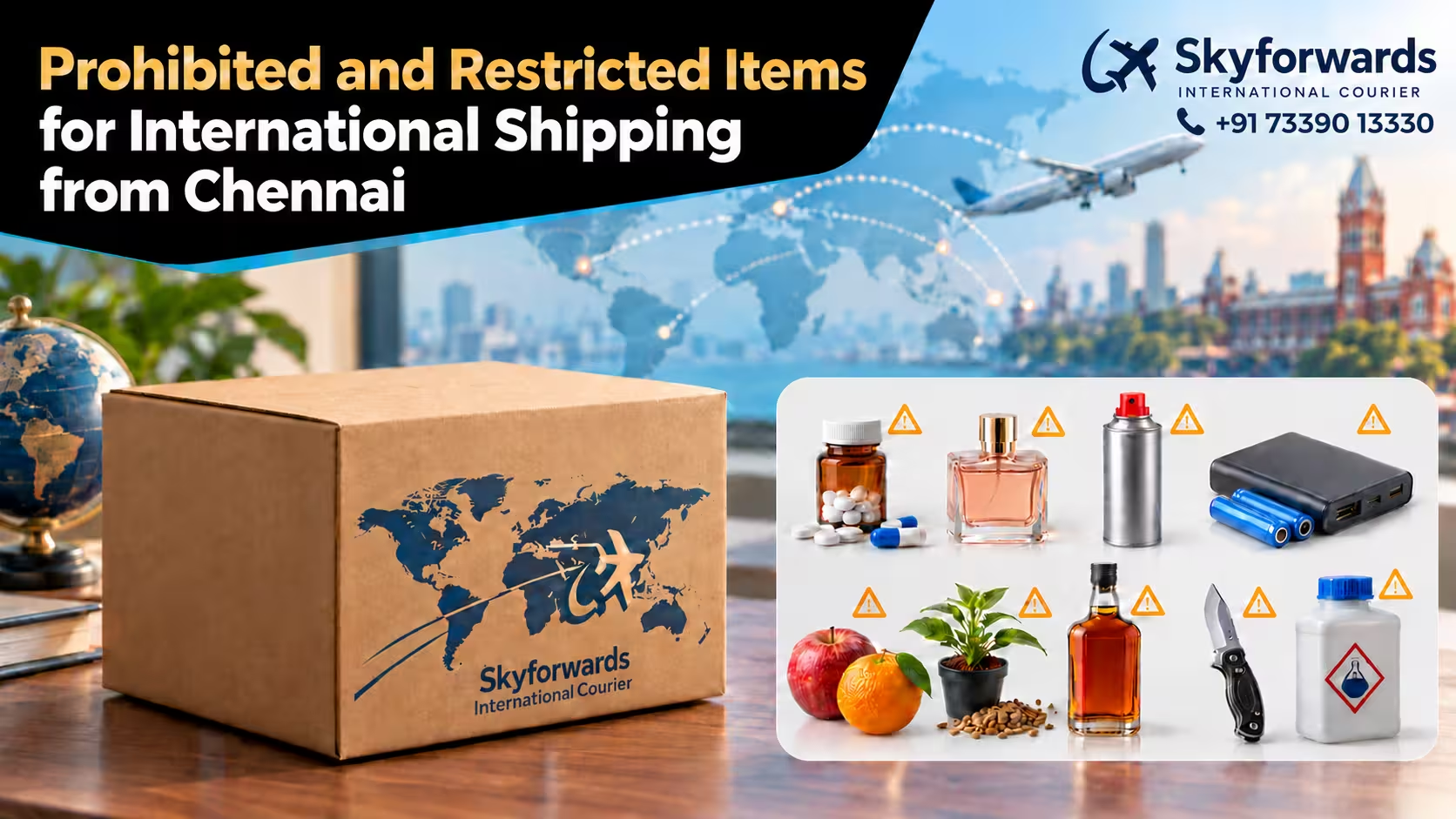
Sending a parcel from Chennai to family, friends or customers abroad is usually simple, but not everything can go in the box. Some items are banned outright, and others can travel only with the right documents, packaging or approval. A parcel that breaks these rules can be delayed, returned, destroyed or held by customs, and the sender or receiver may face penalties.
There is no single list that applies everywhere. What you can send depends on the destination country, the courier service, the exact item and its ingredients, and the regulations in force on the day you ship. Air-transport safety rules, Indian export controls and the destination's import laws all apply at the same time. This guide explains the common problem items and what to check before you pack.
Prohibited vs Restricted Items: What Is the Difference?
- Prohibited items cannot be shipped under the applicable rules, whatever documents you have. For example, Indian law bans the export of e-cigarettes under the Prohibition of Electronic Cigarettes Act, 2019.
- Restricted items may be shipped only if certain conditions are met, such as an import permit, a prescription, a phytosanitary certificate, a dangerous-goods declaration, special packaging, quantity limits or the courier's prior approval.
The same item can be restricted for one country and prohibited for another. A packet of seeds, for example, may need a certificate for one destination and be refused entry by another. That is why none of the items below should be treated as automatically allowed, and most should not be treated as universally banned either.
Why Items Get Restricted
- Air safety: batteries, perfumes, aerosols and flammable liquids can cause fires on aircraft, so they are controlled under ICAO and IATA dangerous-goods rules.
- Biosecurity and health: food, plants, seeds and animal products can spread pests and diseases, so destinations such as the USA and Australia control them closely.
- Medicine and drug laws: medicines may be unapproved or controlled in the destination country, and narcotic or psychotropic ingredients need special authorisation to leave India.
- Customs, tax and security: alcohol, tobacco, currency, jewellery and weapons are controlled for revenue, security or anti-money-laundering reasons.
Common Prohibited and Restricted Items
The table below covers 20 items that customers in Chennai often ask about. Each row explains why the item may be prohibited or restricted and what to check before sending. Links point to the official source for each rule.
| Item | Why it may be restricted | What to check before sending |
|---|---|---|
| Prescription medicines | Most countries treat medicines as regulated imports and may allow only a limited personal-use supply with a prescription. Medicines with narcotic or psychotropic ingredients need an export authorisation from India's Narcotics Commissioner. See also the US FDA personal-import guidance. | Generic and brand name, active ingredients and strength; quantity (months' supply); a copy of the prescription and a doctor's letter; the destination's personal-import rules. |
| Non-prescription medicines | A product sold over the counter in India may be prescription-only, controlled or unapproved abroad. The UK, for example, bans unlicensed and controlled drugs. | Ingredient list on the original pack; whether the destination treats it as a medicine; personal-use quantity; sealed, labelled retail packaging. |
| Vitamins and dietary supplements | Supplements may be regulated as food or medicine, and herbal or animal-derived ingredients can trigger biosecurity or endangered-species rules (Australia). | Full ingredient list (especially herbs, animal parts, hormones); commercial packaging; quantity; destination permit or personal-import limits. |
| Perfumes and aftershaves | Most contain alcohol and are classed as flammable liquids for air transport. | Bottle size and number of bottles; sealed original packaging; whether the courier service accepts flammable liquids to that destination. |
| Aerosol sprays | Aerosols are pressurised and often flammable, so they are dangerous goods in air transport; some, such as spray paint, are not accepted at all. | What the spray is (deodorant, hair spray, paint, insecticide); can size; protected nozzle; whether the courier accepts aerosols on that route. |
| Nail polish and nail polish remover | Both are usually flammable liquids; remover often contains acetone (FAA list of commonly undeclared items). | Quantity and bottle size; ingredients such as acetone; leak-proof sealing; whether the service accepts flammable liquids. |
| Lithium batteries and power banks | Lithium batteries can overheat or catch fire. Air rules set limits by battery type and watt-hour rating, require UN 38.3 testing and short-circuit protection, and treat power banks more strictly from 2026. | Battery type and Wh rating; loose or installed in a device; UN 38.3 test summary; terminal protection; whether the courier accepts loose batteries or power banks at all. |
| Mobile phones and electronics with batteries | Batteries installed in equipment are still regulated under ICAO rules, though usually on easier terms than loose batteries. Damaged or swollen batteries are not safe to ship. | Make and model; new or used; battery condition; device switched off and protected; destination duties; invoice or proof of value. |
| Fresh fruit and vegetables | Produce can carry pests and diseases. Exports may need a phytosanitary certificate, and many destinations prohibit or permit-control personal produce imports. | Exact produce and quantity; whether the destination allows it; phytosanitary requirements; perishability and transit time. |
| Meat, fish and dairy products | Animal products are strictly controlled because of animal-disease risks. The UK and Australia, for example, do not allow most personal meat and dairy imports from India. | Type of product (fresh, dried, canned); whether it contains meat, egg or milk; destination rules; refrigeration needs. |
| Homemade food and snacks | Homemade items usually lack commercial labels and ingredient lists, and ingredients such as meat, dairy, egg or seeds may be prohibited even in a cooked snack (Australia, UK). | Full ingredient list; meat, dairy, egg, nuts or seeds; airtight, leak-proof packing; shelf life; destination food rules. Ask our team whether your food can go to your destination. |
| Seeds and plants | Seeds and live plants are a major biosecurity risk. Exports may need a certificate from India's plant quarantine authority and an import permit at the destination. | Botanical (scientific) name; quantity; commercial packaging and labels; destination permit and phytosanitary requirements. |
| Alcohol | Destinations control alcohol through tax and licensing (US TTB), many carriers restrict it, and high-strength spirits can be flammable dangerous goods. | Type and alcohol percentage; volume; destination limits, duties and taxes; whether the courier accepts alcohol on that route. |
| Tobacco and e-cigarettes | E-cigarettes cannot be exported from India under the 2019 Act. Tobacco faces destination limits and taxes (US CBP). | Do not send e-cigarettes or vapes. For tobacco: product type, quantity, destination limits and whether the courier accepts it. |
| Cash, coins and negotiable documents | RBI rules limit the Indian currency that can be taken out of India, and India Post prohibits sending coins and currency notes. Couriers commonly refuse cash. | Do not pack cash. For cheques or other negotiable documents, check whether the courier accepts them; use bank transfers where possible. |
| Jewellery and precious metals | CBIC has clarified that the courier regulations do not restrict exports of gems and jewellery, but other export laws and procedures still apply, and high value raises customs and insurance questions. | Description, metal purity and weight; declared value with invoice or valuation; personal item or commercial export; insurance. Ask our team about value limits before booking. |
| Knives and sharp tools | Blades can injure handlers, some destinations ban certain knives as offensive weapons, and India Post prohibits unprotected sharp instruments. | Type of knife or tool and blade length; destination weapon laws; sheathing and secure packing so the blade cannot cut through. |
| Firearms, ammunition and weapon parts | Under the Arms Act, 1959, arms and ammunition can only be taken out of India under a licence. Ammunition is also an explosive dangerous good. | Treat as not shippable unless sent through a licensed specialist channel with all permits. Check before packing replica, toy or part items. |
| Chemicals, paints and cleaning products | Many are flammable, corrosive or toxic dangerous goods, and some chemicals are controlled precursors that need a no-objection certificate from the Narcotics Commissioner. | Product name and Safety Data Sheet (SDS); hazard symbols on the label; quantity; whether the courier accepts that hazard class. |
| Flammable liquids and fuels | Fuels, lighter fluid and solvents are flammable dangerous goods that standard courier services generally cannot carry. | Do not send fuels through a standard courier. For equipment that has held fuel, check how it must be drained and cleaned and whether it can be accepted. |
General guidance, not legal advice
Rules change, and the final decision rests with the courier, airline and customs authorities. Always confirm the requirements for your exact item and destination before you pack.
Customer Checklist Before You Book
Have these details ready when you contact the courier. They make it possible to check the rules for your parcel and to prepare accurate customs paperwork.
- Item name and ingredients: the exact product name, brand, and full ingredient or material list.
- Quantity: how many pieces, bottles, packets or months' supply.
- Destination country: and the receiving city or postal code.
- New or used: whether each item is new, used or a gift.
- Approximate value: the value of each item, with an invoice or bill where you have one.
- Parcel weight and dimensions: the packed weight and box size in cm. See our guide to volumetric vs actual weight.
Describe Your Parcel Accurately
Customs officers and courier staff decide what to do with a parcel based on its declared contents. A vague or incomplete description is one of the most common reasons for delays.
- Be specific. Write "2 cotton sarees, 1 steel tiffin box" instead of "gifts" or "personal items". Australia, for example, does not accept descriptions such as "gift" or "goods".
- Declare everything. Include every item, its quantity and a realistic value. Hiding or mis-declaring items can lead to seizure, fines or prosecution.
- Keep original packaging and labels for medicines, supplements, cosmetics and packaged food, so ingredients and expiry dates can be checked.
- Mention batteries. Tell the courier if anything contains a battery, even a toy or a watch. Hidden batteries are a common source of undeclared dangerous goods.
- Ask before you pack. If you are unsure about an item, check with the courier first. It is much easier to remove an item before packing than to recover a parcel held at customs.
Related Skyforwards guides
Frequently Asked Questions
Unsure About an Item?
Contact Skyforwards International Courier at +91 73390 13330 before packing your parcel. Tell us what you plan to send and the destination country so our team can check the requirements.
Sources: rules in this guide were checked in October 2026 against official sources, including IATA, ICAO, CBIC courier regulations, India Post, RBI, US CBP, GOV.UK and Australia's DAFF.
Mouli leads operational logistics for international courier services, overseeing packaging standards and rate optimization across all product categories.
Unsure About an Item?
Tell our team what you plan to send and the destination country before you pack, so we can check the requirements for your parcel.
Related International Courier Guides
International Courier Volumetric Weight vs Actual Weight Charges Explained
Ever wondered why a lightweight box costs more via international courier than a heavy document file? Learn how airline volumetric pricing works and how to pack to save money.
Customs & RegulationsInternational Courier Customs Clearance Guide for Parcels to USA & UK
Avoid package holds, customs fees, and duty surprises when sending documents, homemade food, and gift items to the United States and United Kingdom.